
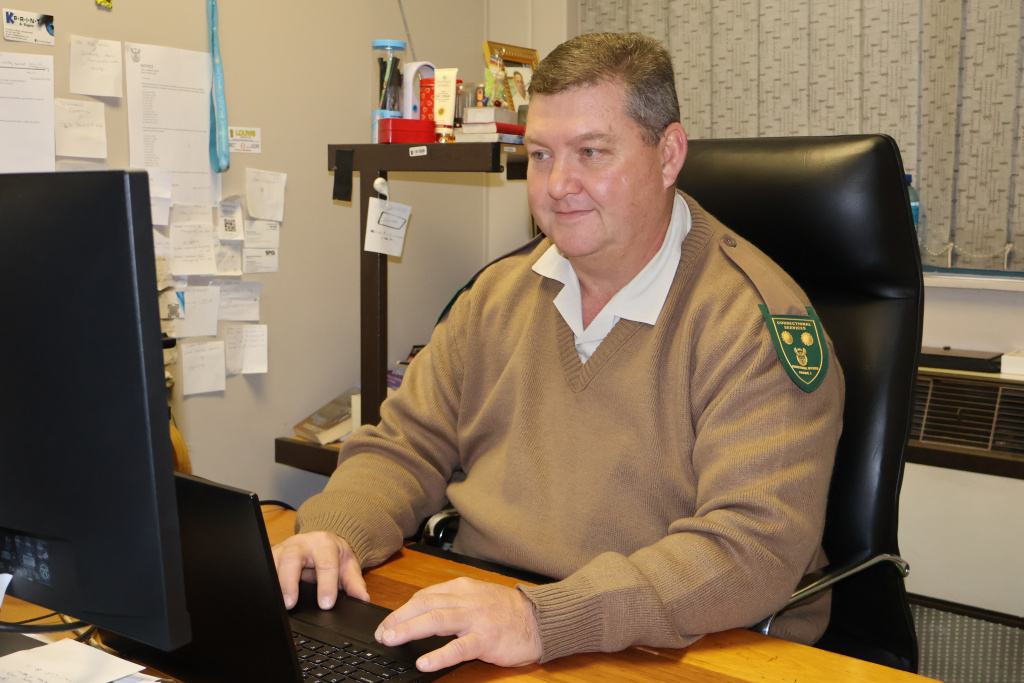
Behind every offender successfully rebuilding their life is a network of people working quietly to make rehabilitation possible. For officials in Community Corrections Branch, the job extends far beyond supervision, it is about protecting communities while helping people find a path as law-abiding citizens.
For Jacques Combrink, Unit Supervisor of Administration and Staff Support, the work is built on a simple belief: people can change when they are given the right support, opportunities and guidance while remaining accountable for their actions.
“My passion is making a positive contribution to public safety and offender rehabilitation,” he says. “Community Corrections allows us to help people reintegrate into society while reducing the risk of recidivism.”
Although much of his work happens behind the scenes, it forms the backbone of Community Corrections. He oversees admissions and releases, court administration, human resources, finance, logistics, transport and security, ensuring officials have the resources and support needed to carry out their responsibilities effectively.
Beyond administration, Community Corrections officers supervise offenders serving sentences in the community through office, home and workplace visits. They assess risks, monitor compliance with parole and correctional supervision conditions, prepare reports and connect offenders with counselling, education, skills development and other rehabilitation programmes.
Because corrections is a societal responsibility families, employers, social workers, community organisations and law enforcement all play an important role in helping offenders rebuild their lives. “Rehabilitation cannot be achieved by the department alone,” he explains. “Communities must become active partners in creating opportunities for change.”
The role has its own challenges. Heavy workloads, limited resources and balancing public safety with rehabilitation require patience, sound judgement and resilience. Yet these difficulties are outweighed by the moments that remind officials why they chose the profession.
“The greatest reward is seeing someone who once struggled become a responsible, law-abiding citizen,” he says. “When an offender finds employment, restores family relationships and contributes positively to society, you know your work has made a difference.”
For young people considering a career in Community Corrections, he recommends studying fields such as Criminology, Psychology, Social Work, Sociology or Correctional Services Management, amongst others. Equally important are qualities such as integrity, empathy, professionalism, strong communication skills and a genuine desire to help others.
His message is simple: Community Corrections is not only about monitoring offenders. It is about restoring hope, strengthening families, reducing recidivism and creating safer communities.